

How DHC Works
Basic Framework
District heating and cooling (DHC) is a system that generates cold water and steam in a plant equipped with heat-source equipment such as chillers and boilers and circulates that cold water and steam through a network of pipes to buildings in the district, round the clock, 365 days a year.
The thermal energy bound up in the cold water and steam delivered is used by HVAC and water-boiling equipment in each building. DHC thus supplies heating and cooling energy to the entire district and is therefore a vital piece of infrastructure.
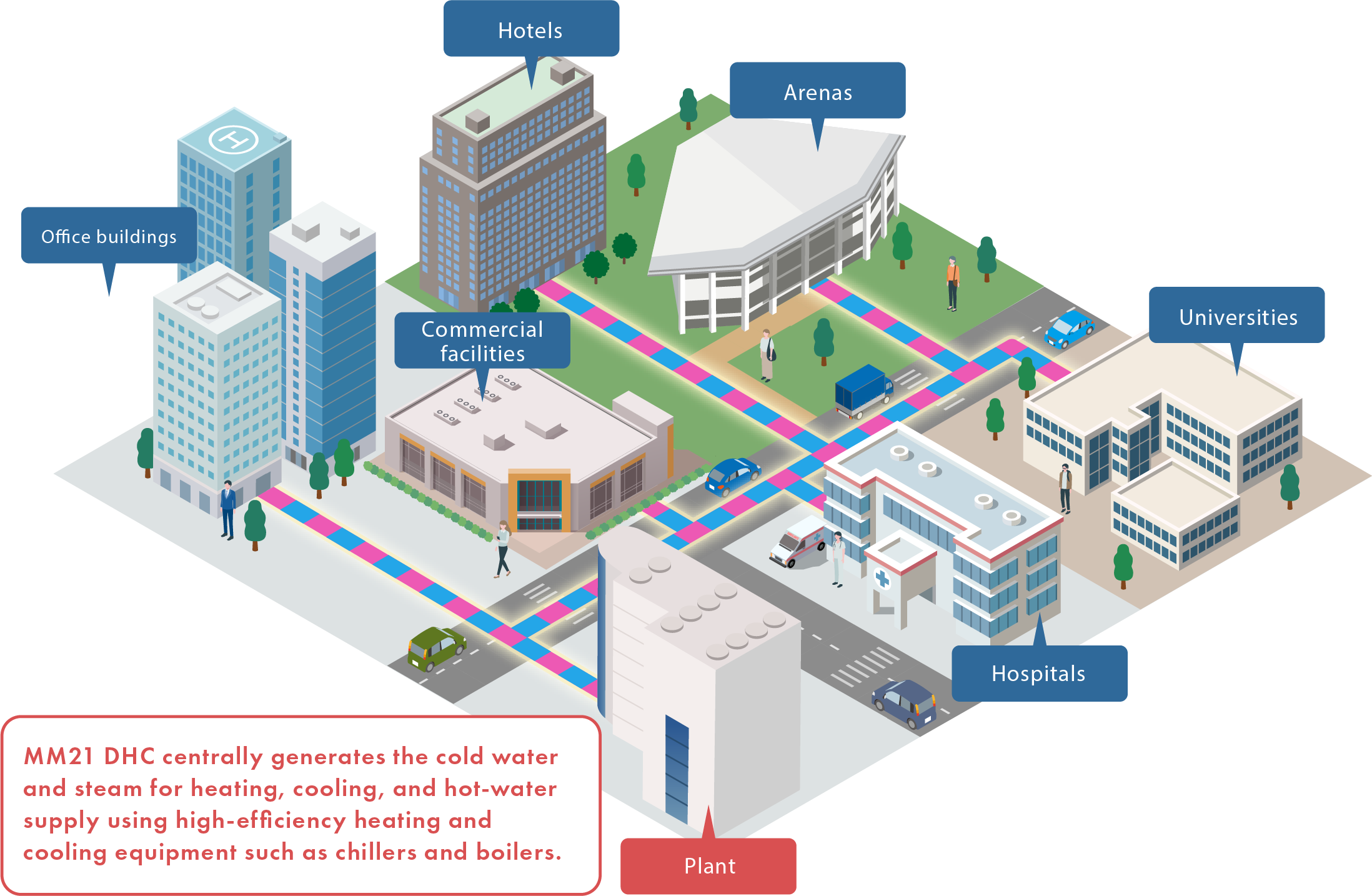
Minato Mirai 21 Central District is supported by Japan’s largest heating and cooling supply system
DHC is more energy-efficient than individual heating and cooling systems, in which heating and cooling equipment is installed in each building. Because of its high energy efficiency, DHC contributes to the reduction of CO2 emissions. DHC is being rapidly installed in central urban areas such as the Minato Mirai 21 Central District, as well as in districts undergoing redevelopment.
Development of Minato Mirai 21 began in 1983. It was decided from the conceptual stage that DHC would be introduced in the entire Central District, enabling supply through shared utility tunnels within the district.
Center Plant began operating in 1989, and construction of No. 2 Plant was completed in the basement of Queen’s Square Yokohama in 1997. Since then, MM21 DHC has gradually increased supply capacity in step with the district’s development. Today, we boast Japan’s highest heating and cooling energy sold for a single sales district.
The needs of customers and other stakeholders are constantly changing, including in energy efficiency and decarbonization. As one of the district’s foremost energy professionals, MM21 DHC is constantly evolving to offer solutions for society’s changing needs.